TL;DR – Article Summary & Notes
- C99500, also known as leaded red brass, is a high-strength copper alloy suited for demanding industrial environments, mining applications, valve components, and various marine usages.
- Sand-cast components can be produced for several end applications that require complex geometries, dimensional stability, and resistance to heavy mechanical loads.
- Erie Bronze & Aluminum now offers C99500 sand casting services for OEMs seeking durable copper-alloy components manufactured to withstand demanding operating environments.
Erie Bronze and Aluminum in Erie, PA, now services OEMs and other industrial customers seeking reliable C99500 casting services for critical components used in mining equipment, gears, valve stems, electrical components, and parts exposed to marine environments. Contact our team today to receive more information or a detailed production quote.
What is Copper Alloy C99500 or “Leaded Red Brass?”
The copper alloy C99500 is a specialized alloy made of a copper-nickel-iron mix that is renowned for its high strength, durability, and corrosion-resistant properties. This specific alloy falls into the class of “Special Alloys” and offers a variety of performance properties that make it ideal for electrical, industrial, and marine applications. For sand-cast C99500 parts, there is one applicable ASTM specification related to copper alloy sand castings for valve applications. ASTM B763 establishes all requirements for copper alloy sand castings for valve applications and requires certain chemical compositions and mechanical properties.
Is C99500 the Same as Leaded Red Brass?
Yes, C99500 is technically the same alloy referred to as “leaded red brass,” despite containing absolutely zero (or negligible) levels of lead. The maximum allowable lead level in C99500 is only 0.09%, a considerably small percentage given the “leaded” name. However, using leaded red brass as terminology is related more to the supplier side of the casting process, and this term is colloquially used in place of UNS C99500 as the mechanical properties of the cast alloy are similar to leaded alloys.
UNS C99500 Benefits, Composition, & Specification Chart
UNS C99500 offers a dependable balance of strength, ductility, stiffness, and end machinability that makes it ideal for uses when strength and wear resistance are critical but manufacturers do not want to compromise other features.
C99500 Composition Chart
| Element | Content (%) |
| Copper (Cu) | 87.9 |
| Nickel (Ni) | 3.50–5.50 |
| Iron (Fe) | 3.0–5.0 |
| Silicon (Si) | 0.50–2.0 |
| Zinc (Zn) | 0.50–2.0 |
| Aluminum (Al) | 0.50–2.0 |
| Manganese (Mn) | ≥ 0.50 |
| Lead (Pb) | ≥ 0.25 |
Despite the “leaded red brass” moniker, the typical makeup of C99500 contains virtually zero lead in the composition. This alloy relies on a considerable amount of copper and small additions of nickel and iron to provide the necessary characteristics expected.
Mechanical Properties of C99500
| Mechanical Property | Metric | Imperial |
| Hardness, Brinell (3000 kg) | 50 | 50 |
| Hardness, Brinell (500 kg) | 145 | 145 |
| Tensile Strength | ≥ 483 MPa | ≥ 70,100 psi |
| Yield Strength | ≥ 275 MPa | ≥ 39,900 psi |
| Elongation at Break (50 mm) | ≥ 12.0% | ≥ 12.0% |
| Machinability* | 50 | 50 |
| Poisson’s Ratio | 0.34 | 0.34 |
| Elastic Modulus | 117 GPa | 16,969 ksi |
*Source: Mechanical Properties Copper Casting Alloy UNS C99500
These mechanical properties provide the following beneficial qualities that are required by industrial equipment manufacturers seeking durable cast parts that can withstand extreme use, consistent wear, and exposure to applied forces.
- Hardness Level: The Brinell hardness levels for C99500 indicate a suitable resistance to indentation, surface deformation, and abrasive wear. While not harder than C955 or C862, it’s still an excellent choice for rugged applications.
- Structural Rigidity: The elastic modulus levels also showcase the alloy’s ability to remain stiff and resistant to elastic deflection while under load. This means that cast parts can maintain their dimensional stability without requiring additional thickness.
- Machinability: C995 has a machinability rating of 50, meaning that it is not exceptionally easy to machine but is still practical for companies to use CNC machining, turning, or drilling operations to refine part design features or achieve tighter tolerances.
Applications for Leaded Red Brass | C99500
Sand cast leaded red brass components, or C995 sand cast parts, are destined for use in any application where the combination of strength, ductility, resistance, and castability provides a practical advantage over other alloys.
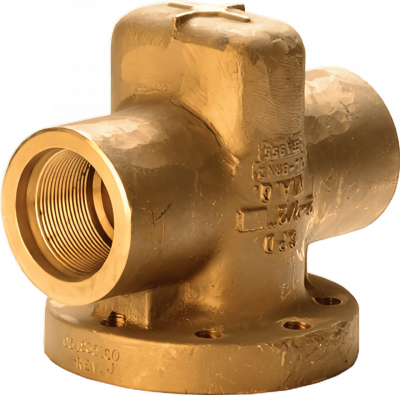
- Valve Bodies & Valve Components: Sand cast valve components fall under ASTM B763/B763M specifications. C99500 castings provide the necessary strength and dimensional stability for high-pressure components.
- Mining Equipment: Mining equipment manufacturers turn to leaded red brass like C995 as it has the requisite tensile and yield strength to perform in demanding industrial applications with extreme forces and loads.
- Marine Components: The corrosion resistance of C99500 allows it to be used in larger, more complex marine applications like propeller wheels where strength and toughness are also desired.
Quotes for C99500 from Erie Bronze & Aluminum
C99500 provides OEMs with a versatile copper alloy for components that must withstand demanding loads, wear, and harsh operating conditions without sacrificing machinability or dimensional stability. Erie Bronze and Aluminum offers sand casting capabilities for C99500 components used throughout mining, marine, valve, and other heavy industrial applications. Contact our team to discuss your specifications and request a quote for your next C99500 casting project.